
Adult social care continues to face enormous workforce demands.
The latest Skills for Care report, published in October 2026, reports that the workforce has grown for a fourth consecutive year and vacancy rates have reduced. That is positive progress.
However, the picture is not suddenly comfortable. Workforce growth is slowing and significant recruitment and retention challenges remain.
Skills England projects that adult social care priority occupations could require around 281,000 additional workers between 2025 and 2035. When estimated replacement demand is included, total workforce demand over that period could be around 685,000 workers.
When staffing remains under pressure, safe and efficient care becomes even more important.
Moving and handling is a good example.
Completing training does not automatically make a handling plan safe
Most care providers understand the importance of moving and handling training.
But there is an important difference between teaching somebody the principles of safer handling and deciding how a particular person should be assisted.
Those are not the same thing.
A member of staff might competently demonstrate use of a hoist during training.
That does not tell us which sling is appropriate for a particular resident.
It does not tell us whether that resident needs one member of staff or two.
It does not tell us whether standing equipment remains appropriate.
It does not tell us whether the bedroom provides enough space.
It does not tell us how pain, cognition, fatigue, fear or fluctuating ability affect the transfer.
Training develops staff competence.
Assessment determines the care plan.
Both are needed.
Moving and handling should never become a routine
The Health and Safety Executive identifies moving and handling as a major part of work within health and social care and emphasises the importance of managing the risks associated with it.
One of the difficulties in care environments is that handling routines can become established very quickly.
“We always use two carers.”
“He has always used that sling.”
“We always use the stand aid.”
“She needs lifting because she cannot walk.”
These statements should trigger questions rather than end the discussion.
What can the person actually do?
Has their ability changed?
Could they participate more?
Is the current method creating unnecessary dependency?
Has the equipment been reviewed?
Is the care plan based upon a recent functional assessment or simply historical practice?
Sometimes the safest plan requires significant assistance.
Sometimes equipment is essential.
But unnecessarily doing something for a person can gradually remove opportunities for them to do it themselves.
That matters occupationally.
Good handling can support rehabilitation
Moving and handling assessment should consider capability as well as risk.
If someone can contribute to rolling in bed, they should usually be encouraged to contribute.
If they can push through their legs during a transfer, that ability matters.
If they can reach for a rail and reposition themselves, that movement should be incorporated where appropriate.
The goal is not to make every transfer independent.
The goal is to maximise safe participation.
This can support confidence, physical function and the person’s sense of control over their own care.
Equipment should not replace clinical reasoning
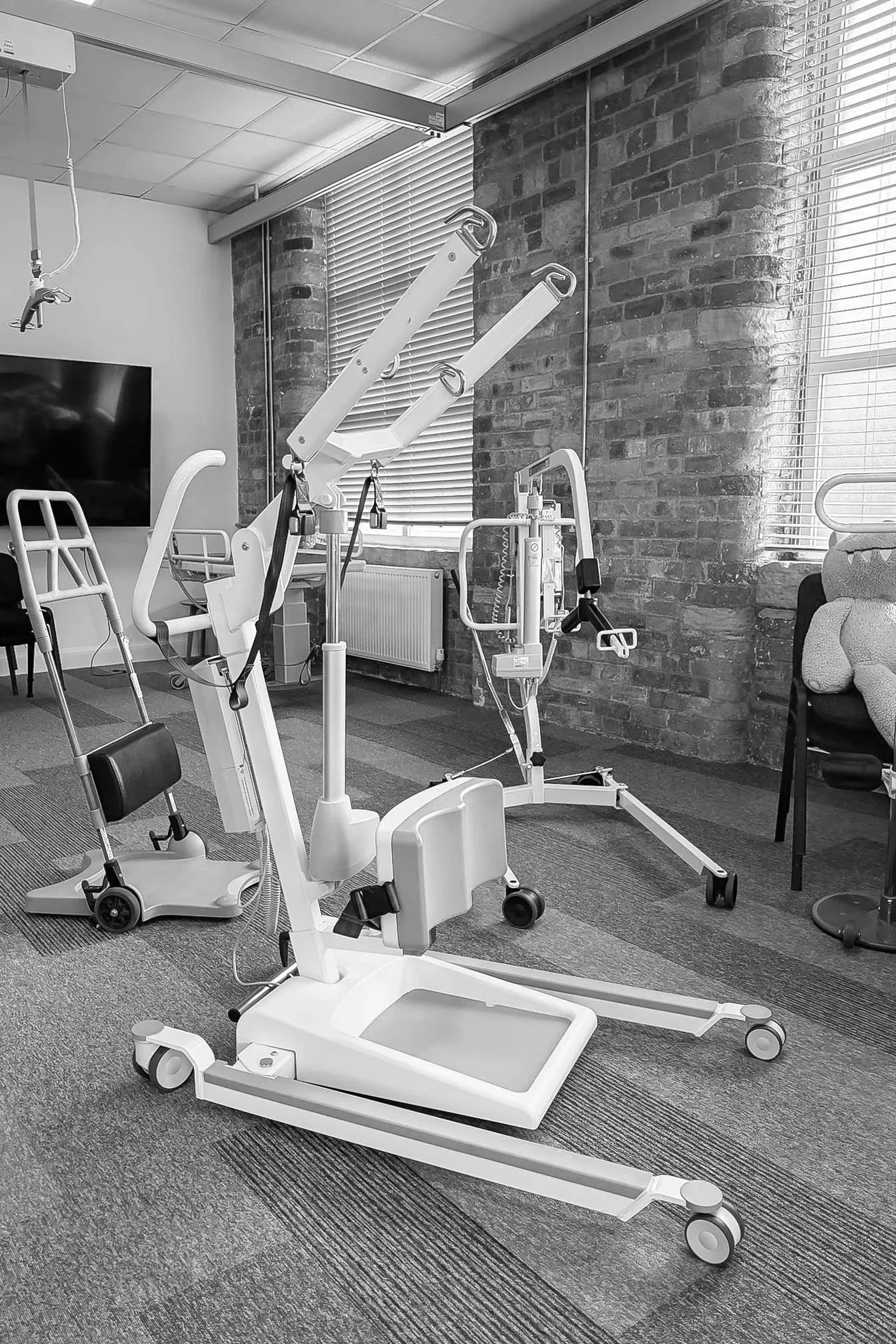
Hoists, slings, standing aids, transfer devices and profiling beds are excellent tools when appropriately selected.
But the equipment must match the individual.
Sling shape and size affect positioning.
A standing aid requires sufficient physical and cognitive ability.
A hoist needs enough physical space to operate.
A profiling bed can assist repositioning but may also change transfer height.
Specialist seating may reduce the frequency of difficult repositioning interventions.
These pieces of equipment should therefore be considered together rather than in isolation.
How OT4Life can help
OT4Life provides moving and handling assessments, care plan reviews, equipment recommendations and practical staff training.
We can assess complex transfers, review single and multiple carer handling approaches, advise upon hoists and slings, evaluate standing equipment and support care providers where a resident’s needs have changed.
We also provide practical moving and handling training designed around real care environments rather than simply completing a classroom exercise.
Because the goal is not just to move somebody from A to B.
It is to do it safely, with dignity, while preserving as much ability as possible.
Source information: Skills for Care published its latest workforce report on 14 October 2026. Skills England has separately projected substantial future workforce demand across adult social care.