
When people hear the words “moving and handling assessment”, they often assume the assessment will focus solely on hoists, slings, transfers and reducing risk.
Those elements are important, but a good moving and handling assessment should go much further.
At OT4Life, we consider how moving and handling affects the person’s whole day. A wheelchair, specialist chair or profiling bed is not simply a surface that someone transfers onto. It may be where they eat, communicate, use a computer, complete artwork, spend time with family or manage fatigue.
A handling plan can be technically safe while still being clinically poor.
For example, a person may be transferred safely into a chair, but if their posture is not adequately supported, they may be unable to feed themselves, use their arms effectively or tolerate sitting for a meaningful period. Similarly, an unsuitable sling may complete the transfer but leave the person uncomfortable, poorly positioned or unable to participate in the next activity.
This is why occupational therapy brings something different to moving and handling.
We look at the whole task
A moving and handling assessment should consider:
The person’s strength, movement, pain, fatigue, cognition and communication.
The activity they are trying to complete.
The environment in which the activity takes place.
The equipment being used.
The skills, physical abilities and confidence of the carers providing support.
The person’s dignity, preferences and longer term goals.
Risk cannot be removed by focusing on equipment alone.
A hoist may be required, but the correct sling, attachment points, positioning and transfer route must also be considered. A profiling bed may reduce the physical demands placed on carers, but only when there is sufficient space, a suitable mattress and an appropriate method of repositioning.
Protecting carers without removing independence
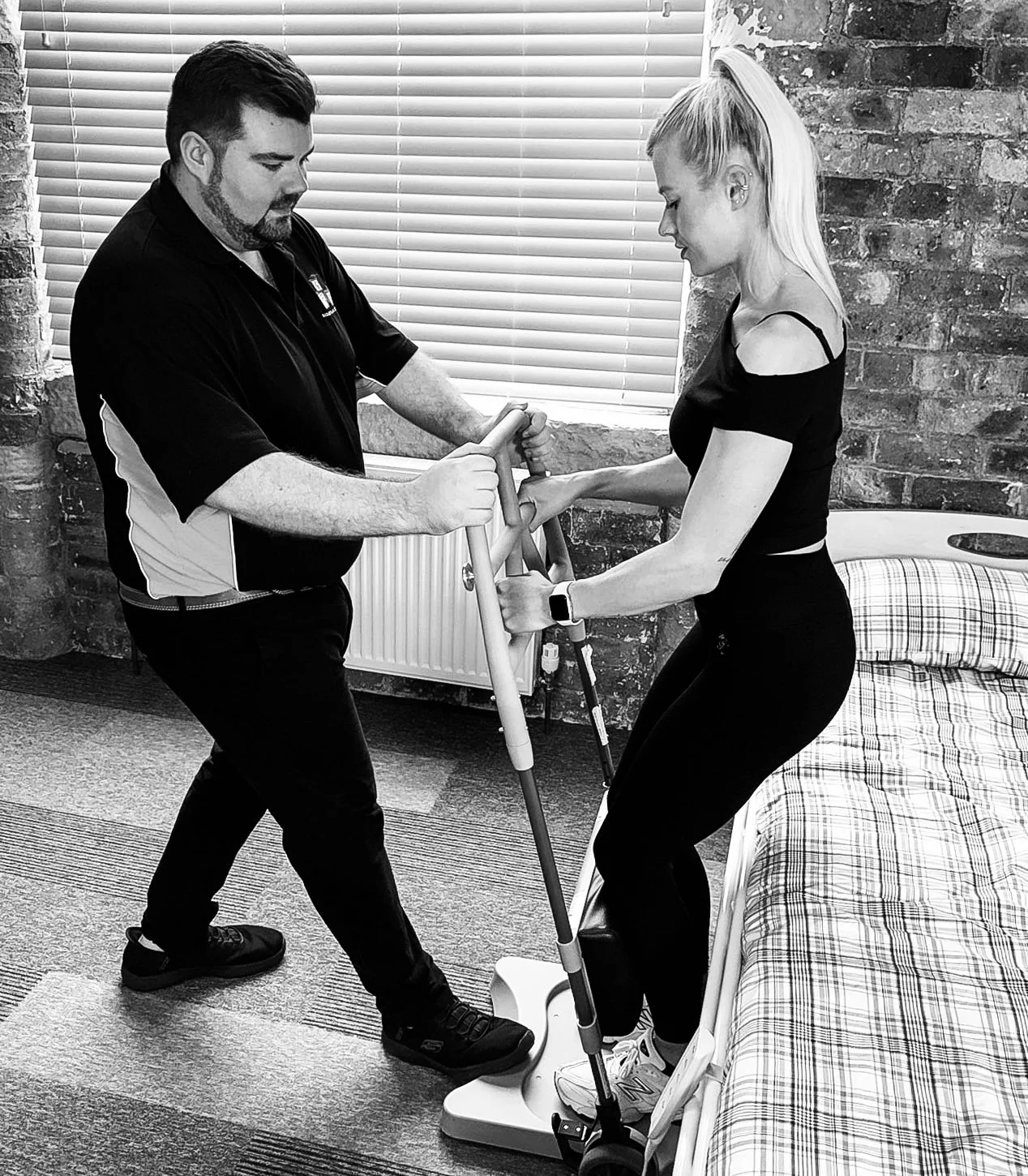
There can be a tension between reducing moving and handling risk and maintaining the person’s abilities.
The solution is not to ignore risk. It is also not to remove every opportunity for the person to participate.
The aim should be to identify what the person can still do safely and consistently. This may include using their arms to assist with rolling, completing part of a sit to stand transfer, adjusting their own position or directing carers during a hoist transfer.
Preserving participation can support confidence, dignity and physical function.
However, continuing with unsafe manual lifting because “this is how we have always done it” is not person centred. It places both the individual and the carer at risk and often becomes unsustainable as needs increase.
A good plan must work in real life
Moving and handling recommendations must be practical.
The equipment must fit within the home.
Carers must understand the technique.
The plan must be achievable during routine care calls.
The person must be able to tolerate the position and transfer.
The approach must remain appropriate when the person is tired, unwell or having a difficult day.
OT4Life provides moving and handling assessments, equipment recommendations, carer guidance, and practical training for individuals, families, care providers, and case managers. Our goal is not simply to complete a safe transfer. It is to make sure the transfer enables the person to continue living their life.